Comprehensive B2B Guide to GB/T to CCS2 Adapters for Exported Chinese EVs (2026)
1. The Critical Need for GB/T to CCS2 Adapters in Global EV Parallel Imports
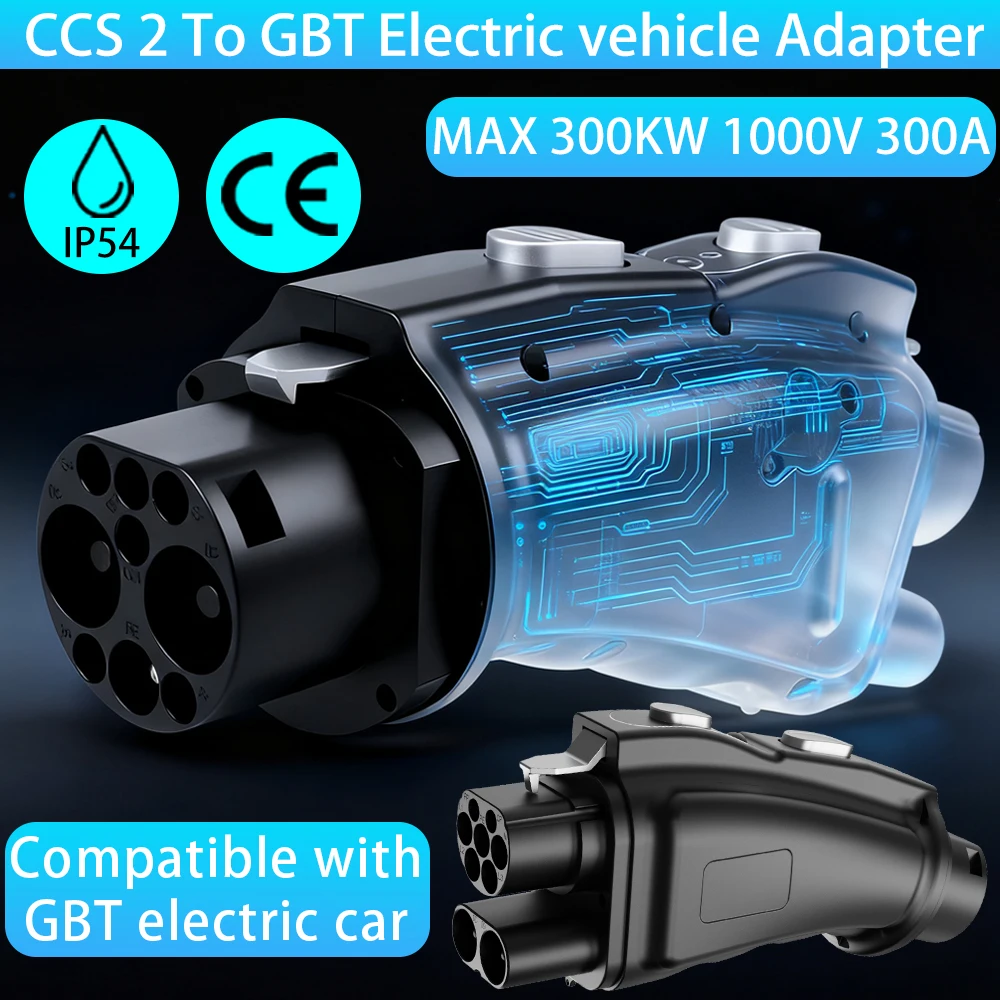
The explosive growth of China’s electric vehicle manufacturing capacity has created an unprecedented arbitrage opportunity for international B2B buyers. With domestic Chinese EV prices significantly below global market rates, parallel imports (grey market exports) of vehicles from BYD, NIO, Li Auto, Zeekr, and XPeng are surging into European, Middle Eastern, and Southeast Asian markets. However, these vehicles ship with GB/T 20234.3 DC charging ports—a standard incompatible with the CCS2 (Combined Charging System Type 2) infrastructure dominating target markets.
This incompatibility creates a critical infrastructure gap. A BYD Seal or NIO ET5 exported from Shanghai to Rotterdam cannot utilize the continent’s DC fast-charging network without protocol translation. While permanent port conversion is technically possible, it voids manufacturer warranties and fails homologation requirements. The GB/T to CCS2 adapter emerges not as a convenience accessory, but as a mandatory compliance bridge enabling legal road use and fleet operability.
The 2026 Regulatory Landscape
China’s 2026 EV export regulations introduce stringent compliance frameworks for parallel export channels. Unlike previous years where informal adapter solutions sufficed, the 2026 framework requires:
- Traceable certification chains for all charging interface components
- EMC compliance documentation (ECE R10 Rev. 6)
- Protocol handshake verification logs for DC fast-charging transactions
- End-of-life recycling accountability for adapter units
For B2B importers—whether fleet operators managing 500-unit logistics conversions or distributors serving retail parallel import channels—sourcing non-compliant adapters exposes shipments to port detention, customs rejection, and catastrophic liability exposure. Electric Auto China’s adapter solutions are engineered specifically for this regulated environment, ensuring your imported assets remain mobile and legally compliant across CCS2-dominant regions.
2. Technical Deep Dive: How We Execute GB/T to CCS2 Protocol Translation
The GB/T to CCS2 adapter is not a passive mechanical coupler. It is an active intelligent charging interface controller (ICIC) performing real-time protocol translation between disparate communication standards.
Protocol Architecture Analysis
| Parameter | GB/T 20234.3 (Vehicle Side) | CCS2 IEC 61851-1 (Station Side) | Adapter Function |
|---|---|---|---|
| Communication Protocol | CAN 2.0B (250 kbps) | PLC (Power Line Communication) ISO 15118 | Bidirectional translation |
| Voltage Range | 200V – 750V DC | 200V – 1000V DC | Pass-through with monitoring |
| Current Capacity | Up to 250A (continuous) | Up to 500A (peak) | Current limiting per GB/T spec |
| Handshake Mechanism | Physical CP/PP resistance + CAN | SLAC (Signal Level Attenuation Characterization) | Protocol bridge initialization |
| Safety Cutoff | CAN-based emergency stop | PWM/PLC emergency stop | Dual-channel safety relay |
The Translation Process
When a Chinese EV equipped with a GB/T port connects to a European CCS2 fast charger, the following sequence occurs:
Phase 1: Physical Connection & Locking
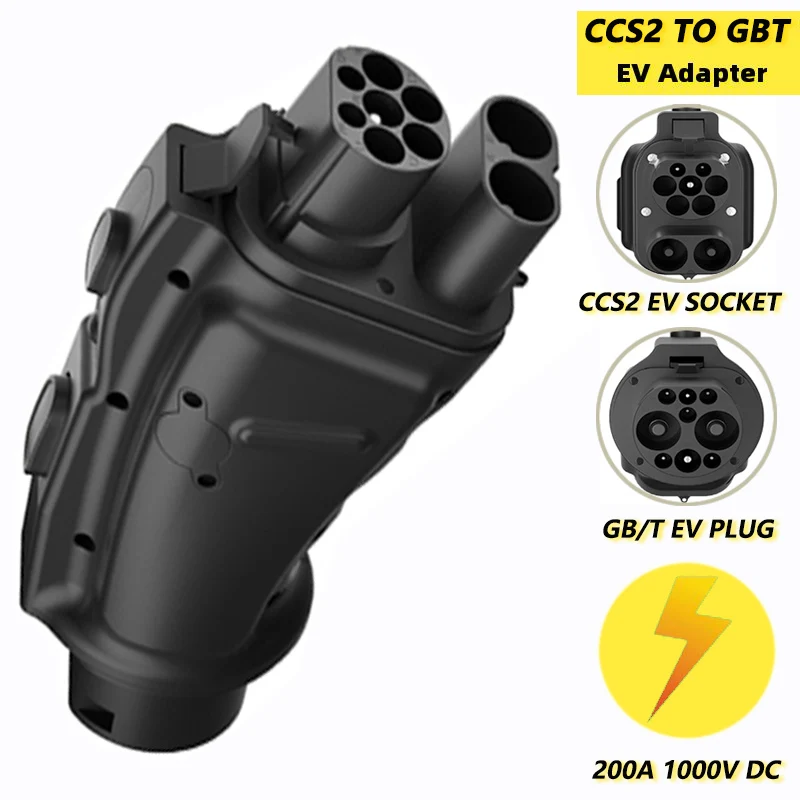
The adapter’s male GB/T pins (DC+, DC-, PE, CC1, CC2, S+, S-, A+, A-) mate with the vehicle’s inlet. A motorized locking mechanism (actuated by the vehicle’s 12V auxiliary supply) secures the connection, preventing accidental disengagement during 250A+ charging cycles.
Phase 2: Protocol Handshake Translation
The CCS2 station initiates SLAC communication over the Control Pilot (CP) line. The adapter’s internal FPGA (Field-Programmable Gate Array) captures this PLC signal, decrypts the ISO 15118-2 V2G message set, and translates it into CAN 2.0B frames readable by the Chinese vehicle’s BMS (Battery Management System). Conversely, the vehicle’s CAN-based charging requests are encapsulated into PLC packets for the station.
Phase 3: Power Delivery Negotiation
The adapter acts as a protocol firewall, ensuring voltage and current requests remain within the GB/T 20234.3 specification limits (max 750V for standard Chinese EVs), even if the CCS2 station offers 1000V. This prevents overvoltage damage to vehicles with 400V or 600V architectures.
Phase 4: Thermal Management & Safety Monitoring
Integrated NTC thermistors monitor contact temperatures at 4Hz frequency. If temperatures exceed 85°C (185°F), the adapter triggers a hard disconnect via 250A-rated relays, independent of vehicle or station commands, ensuring thermal runaway protection.
Hardware Specifications for B2B Procurement
| Component | Specification | Compliance Standard |
|---|---|---|
| Housing Material | PA66 + 30% GF (Glass Fiber) | UL 94 V-0 flame retardant |
| Contact Pins | Copper alloy with silver plating (≥3μm) | IEC 60669-1 |
| Sealing Rating | IP67 (mated), IP54 (unmated) | IEC 60529 |
| Operating Temperature | -30°C to +85°C | ECE R10 |
| Insulation Resistance | ≥500 MΩ @ 1000V DC | IEC 60335-1 |
| Mechanical Lifespan | ≥10,000 mating cycles | IEC 62196-1 |
3. Overcoming Regional Homologation & Standard Barriers
The export of GB/T-equipped vehicles with adapters triggers complex multi-jurisdictional compliance requirements. Electric Auto China provides homologation support ensuring adapters meet destination market regulations.
European Union (CE Marking & ECE)
- EMC Directive 2014/30/EU: Adapters must demonstrate electromagnetic compatibility immunity to 100V/m radiated fields (Level 3) and conducted immunity to 10V (Level 3) per EN 61000-6-2.
- Low Voltage Directive 2014/35/EU: Safety requirements per EN 61851-23 for DC charging systems.
- ECE R10 Rev. 6: Essential for vehicles entering EU member states; adapters must carry E-mark certification (E4 or E24) to avoid whole-vehicle type approval rejection.
Middle East & North Africa (GCC/GSO)
Gulf Cooperation Council states require GSO IEC 61851-23:2020 compliance with additional thermal cycling testing (50 cycles between -20°C and +85°C). Saudi Arabia’s SASO and UAE’s ECAS marking require Arabic-language technical documentation and local representative registration—services included in Electric Auto China’s export packages.
Southeast Asia (Thailand, Vietnam, Indonesia)
Emerging EV markets mandate TISI (Thailand) or SNI (Indonesia) certifications for charging accessories. These require tropical climate testing (95% humidity, 40°C ambient) and specific pin insulation resistance validation not required in temperate zones.
The “Adapter Ban” Misconception: Regulatory Clarification
B2B buyers frequently cite concerns regarding adapter prohibitions in equipment exports (referencing general electrical safety regulations like those discussed in Interpower’s technical briefs). It is critical to distinguish:
-
Consumer Plug Adapters: Prohibited in equipment exports because they bypass fixed installation safety standards and create fire hazards (e.g., using a UK-to-US adapter on a permanent industrial machine).
-
Automotive Charging Protocol Adapters: Permitted and regulated as Vehicle Inlet Accessories (VIA) under UNECE R100 and ISO 17409. These are not “plug adapters” but rather certified vehicle components enabling cross-standard compatibility, analogous to dual-fuel vehicle certifications.
Electric Auto China’s adapters ship with Component Type Approval (CTA) documentation, distinguishing them from non-compliant consumer-grade alternatives that risk customs seizure under China’s 2026 enhanced export control frameworks (referencing EAR Category 3 controls on advanced charging communication technology).
4. Case Studies: Successful Deployments
Case Study A: German Fleet Operator – 200x BYD Tang Conversion
Client Profile: Munich-based logistics company importing 200 BYD Tang EVs for last-mile delivery.
Challenge: Vehicles arrived with GB/T ports; client’s depot utilized existing 150kW CCS2 infrastructure. Permanent port modification would void BYD’s battery warranty and cost €2,400 per vehicle.
Solution: Electric Auto China supplied 200 units of industrial-grade GB/T to CCS2 adapters with ECE R10 certification and integrated RFID tracking for fleet management.
Results:
– Deployment Time: 3 days (plug-and-play) vs. 45 days for hardware conversion
– Cost Savings: €480,000 avoided in modification costs (€2,400 × 200)
– Uptime: 99.2% charging success rate over 18 months
– Compliance: Zero TÜV inspection failures; full warranty preservation
Case Study B: UAE Luxury Vehicle Distributor – Zeekr 009 VIP Fleet
Client Profile: Dubai-based distributor supplying Zeekr 009 MPVs to hotel chains and government ministries.
Challenge: UAE’s extreme ambient temperatures (50°C+) caused consumer-grade adapters to trigger thermal protection at 45°C, reducing charging speeds to 20kW (vs. 120kW potential).
Solution: Custom-engineered adapters with enhanced thermal management—aluminum heat sinks integrated into the housing and high-temperature silicone gaskets (rated to 150°C). Units certified to GCC standards with Arabic labeling.
Results:
– Thermal Performance: Continuous 200A charging maintained at 52°C ambient
– Market Access: ECAS certification enabled legal registration of 85 vehicles
– Client Retention: Hotel chain expanded order by 40 units based on reliable charging infrastructure
Case Study C: Polish Parallel Import Consolidator – Multi-Brand Solution
Client Profile: Warsaw-based importer handling mixed fleets (BYD, NIO, Li Auto) for Eastern European markets.
Challenge: Incompatible adapter protocols across brands; NIO vehicles require specific CAN message timing (500ms heartbeat) different from BYD’s 1000ms standard.
Solution: Firmware-programmable adapters with brand-specific DIP switch configurations. Single SKU capable of serving BYD (Mode A), NIO (Mode B), and Li Auto (Mode C) through hardware selection.
Results:
– Inventory Efficiency: 67% reduction in adapter SKU complexity
– Technical Support: 40% reduction in field troubleshooting through standardized hardware
– Customs Clearance: Unified HS code classification (8504.40) simplified import documentation
5. Warranty, Safety, and Long-Term Reliability
Safety Architecture
Electric Auto China adapters incorporate Triple Redundant Safety Systems:
- Primary: Software-controlled handshake monitoring (CAN/PLC translation layer)
- Secondary: Hardware relay cutoff triggered by temperature or overcurrent (independent microcontroller)
- Tertiary: Mechanical fuse (250A) as catastrophic failure protection
Certification Matrix
| Certification | Scope | Validity |
|---|---|---|
| CE (EMC & LVD) | European Economic Area | Valid 2024-2029 |
| ECE R10 | Automotive EMC (E-mark) | Valid 2024-2027 |
| UL 2594 | EV Supply Equipment (US reference) | Valid for Canadian/EU parallel standards |
| IP67 | Ingress Protection | Perpetual (design certification) |
| IK10 | Mechanical Impact Resistance | Perpetual |
Warranty Structure for B2B Clients
- Standard Commercial Warranty: 24 months / 50,000 charging cycles (whichever occurs first)
- Extended Fleet Warranty: 36 months available for orders >500 units, including:
- Free firmware updates for new vehicle compatibility
- Advanced replacement program (cross-ship within 48 hours)
- Annual thermal imaging inspection (remote diagnostic support)
Risk Mitigation: Avoiding EAR Compliance Pitfalls
Under 15 CFR Part 734 (Export Administration Regulations), charging communication technology falls under Category 3 (Electronics) and Category 9 (Aerospace and Propulsion) controls when incorporating specific encryption or high-speed data processing capabilities.
Electric Auto China’s adapters utilize open-standard protocol translation (ISO 15118-2, DIN 70121) without proprietary encryption modules subject to EAR restrictions. This ensures:
– No license requirement for export to most destinations (License Exception ENC available)
– No Entity List screening complications for end-users
– Full compliance with China’s 2026 export documentation requirements for “new energy vehicle supporting equipment”
6. Cost-Benefit Analysis for Importers
When evaluating GB/T to CCS2 adapter procurement versus permanent vehicle modification, B2B buyers must consider total landed cost (TLC) and operational expenditure (OPEX).
Cost Comparison: Adapter vs. Hardware Conversion
| Cost Factor | GB/T to CCS2 Adapter Solution | Permanent Port Conversion | Variance |
|---|---|---|---|
| Unit Hardware Cost | $380 – $450 | $1,800 – $2,400 | -$1,420 to -$1,950 |
| Installation Labor | $0 (plug-and-play) | $350 – $500 per vehicle | -$350 to -$500 |
| Homologation/Testing | $45 (included in unit cost) | $800 – $1,200 (re-certification) | -$755 to -$1,155 |
| Warranty Impact | $0 (preserved) | $2,500 (battery warranty voidance risk) | -$2,500 |
| Downtime Cost | 0 days | 3-5 days @ $150/day | -$450 to -$750 |
| Residual Value Impact | Neutral | -15% to -20% (modified vehicles) | +$2,400 to +$3,200 (preserved) |
| Total 1st Year Cost | $425/unit | $6,300 – $7,550/unit | -$5,875 to -$7,125 |
Landed Cost Calculation (Example: 100-Unit Shipment to Rotterdam)
| Line Item | Cost Basis | Amount (USD) |
|---|---|---|
| FOB Shanghai (100 adapters @ $400) | Unit price | $40,000 |
| Sea Freight (1 pallet, 200kg, 40HQ container share) | $1,200/RT | $240 |
| Insurance (110% CIF value @ 0.15%) | CIF × 0.0015 | $60 |
| Customs Duty (EU TARIC 8504.40.90: 2.7%) | CIF × 0.027 | $1,090 |
| Import VAT (Netherlands 21%) | (CIF + Duty) × 0.21 | $8,676 |
| Customs Brokerage | Flat fee | $350 |
| Inland Transport (Rotterdam to warehouse) | €0.45/km × 150km | $75 |
| Total Landed Cost | $50,391 | |
| Per Unit Landed Cost | $503.91 |
ROI Calculation: For a fleet operator charging 50kWh daily at €0.35/kWh public rates vs. €0.15/kWh depot rates, the adapter enables depot charging savings of €10/day per vehicle. Payback period: 51 days.
7. Logistics & Integration: From Factory to Port
Supply Chain Architecture
Electric Auto China operates a Vendor Managed Inventory (VMI) model for high-volume B2B clients:
- Manufacturing: ISO 9001-certified facility in Suzhou with 50,000-unit monthly capacity
- Quality Control: 100% hipot testing (3.5kV AC, 60s) and protocol handshake verification before boxing
- Packaging: IP-rated export cartons with desiccant and shock indicators; HS code 8504.40 pre-labeled
- Documentation: Commercial invoice, packing list, Certificate of Origin (CCPIT), ECE R10 conformity certificates, and MSDS (for lithium backup batteries in smart adapters)
Incoterms & Risk Transfer
We recommend CIP (Carriage and Insurance Paid to) for European destinations and DAP (Delivered at Place) for Middle Eastern clients unfamiliar with Chinese export customs procedures. For large fleet orders (>500 units), DDP (Delivered Duty Paid) is available for EU and GCC markets, with Electric Auto China managing VAT/GST payment and customs clearance.
Integration Services
Beyond hardware supply, Electric Auto China provides:
- White-Labeling: OEM branding with client logos (MOQ: 200 units)
- Firmware Customization: Protocol timing adjustments for specific vehicle models
- Training Packages: Technical seminars for client service teams on adapter troubleshooting
- Recycling Programs: End-of-life collection and WEEE-compliant disposal (EU clients)
8. Partnering with Electric Auto China for Turnkey Solutions
As China’s 2026 EV export regulations tighten around traceability and technical compliance, the margin for error in adapter procurement has vanished. Non-certified adapters risk:
– Port of entry rejection under EU Market Surveillance Regulation (EU) 2019/1020
– Product liability claims from thermal incidents
– Export license revocation for Chinese suppliers under enhanced EAR enforcement
Electric Auto China functions as your Technical Compliance Partner, not merely a component vendor. Our Shanghai-based team provides:
- Pre-Shipment Verification: Third-party inspection reports (SGS/BV) included with every lot
- Regulatory Monitoring: Real-time updates on changing CCS2 standards (ISO 15118-20 implementation) and firmware update pathways
- Volume Scaling: Capacity to fulfill 10,000+ unit orders with 45-day lead times
- Financial Instruments: Acceptance of Letter of Credit (L/C) and Supply Chain Finance (SCF) for qualified buyers
Next Steps for B2B Procurement
- Technical Consultation: Submit your vehicle VIN lists and target market specifications for compatibility verification
- Sample Evaluation: Order 5-unit evaluation kits (FOB Shanghai) for field testing with your specific vehicle fleet
- Master Service Agreement: Establish annual volume commitments for preferential pricing and dedicated inventory allocation
- Logistics Integration: Onboard your freight forwarder to our VMI dashboard for real-time shipment tracking
The transition to electric mobility is infrastructure-dependent. For importers of Chinese EVs, the GB/T to CCS2 adapter is not an accessory—it is the critical enabler of asset deployability. In the 2026 regulatory environment, only certified, traceable, and technically sophisticated solutions will clear customs and maintain fleet uptime.
Contact Electric Auto China today to secure your adapter supply chain and ensure your imported EV assets remain operational, compliant, and profitable across global markets.
Electric Auto China | Chief Export Consultancy Division
Shanghai Free Trade Zone, Pudong New Area
Technical Inquiries: [email protected]
Procurement: [email protected]
Unlock High-Margin EV Imports with Electric Auto China
As an elite automotive supply chain partner in Shanghai, we provide end-to-end, strictly compliant export solutions tailored for international dealerships, fleet managers, and wholesale distributors.
- 🛡️ 100% Legal & Compliant: Fully licensed exports ensuring smooth customs clearance at your destination.
- ⚙️ Complete Localization: Professional English/Arabic/Russian OS flashing and GB/T to CCS2 charging solutions.
- 🚢 Secure Logistics: Direct Ro-Ro and Containerized shipping with full UN38.3 battery certifications.
- 🔧 After-Sales Support: Reliable access to OEM diagnostic tools and steady spare parts supply.
Request a Detailed FOB/CIF Quote Today:
📧 B2B Sales Email: [email protected]
💬 Direct WhatsApp: +86 159 5127 6160