Comprehensive B2B Guide to Tesla to GB/T Adapter for Exported Chinese EVs (2026)
1. The Critical Need for Tesla to GB/T Adapter in Global EV Parallel Imports
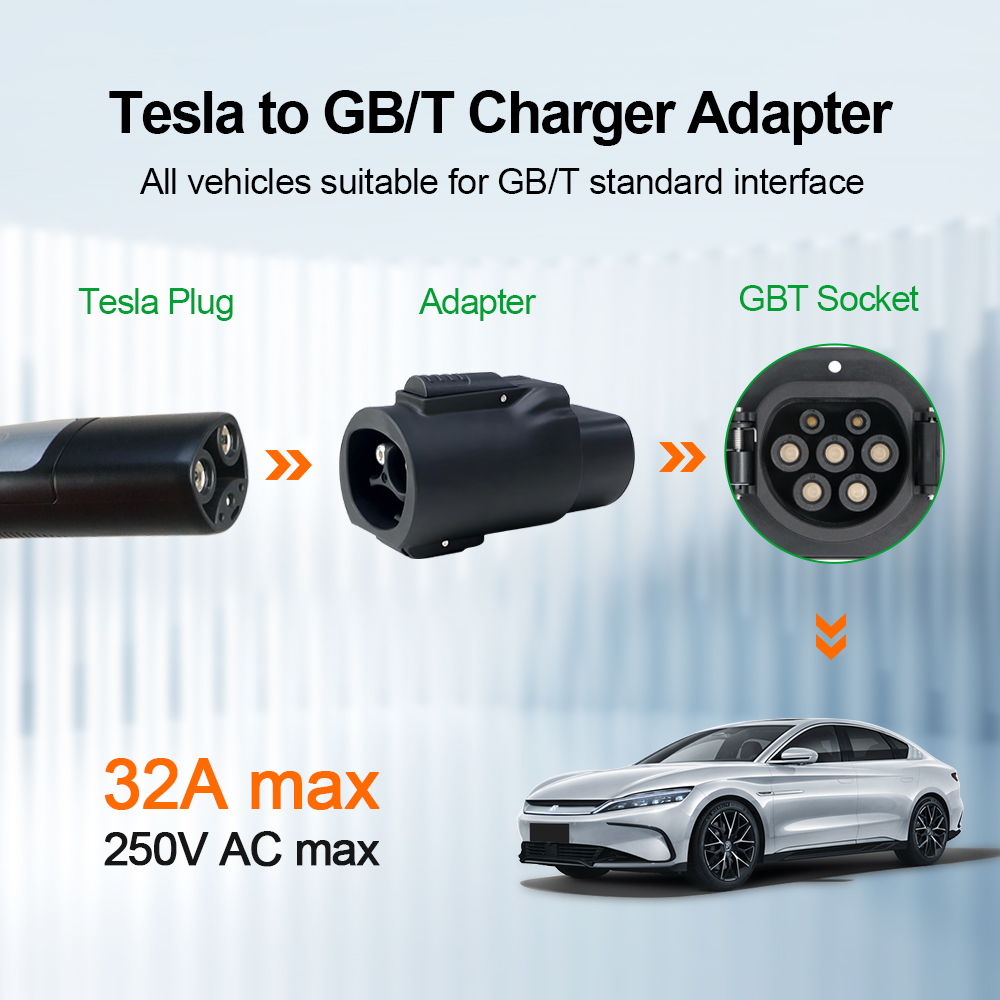
The global electric vehicle supply chain is experiencing unprecedented fragmentation due to regional charging standard divergences. As China’s domestic EV manufacturers—BYD, NIO, Li Auto, Zeekr, and XPeng—ramp up export volumes to North American, Middle Eastern, and Southeast Asian markets, a critical infrastructure compatibility gap has emerged. Chinese-specification vehicles equipped with GB/T 20234.2 charging inlets (the mandatory standard for all EVs sold within China) face immediate operational paralysis when encountering the North American Charging Standard (NACS), commonly known as the Tesla connector, which dominates the North American and increasingly global charging infrastructure.
The 2026 Export Landscape and Charging Standard Divergence
By 2026, industry projections indicate that over 4.2 million Chinese-manufactured EVs will require cross-border charging compatibility solutions. The GB/T standard (Guobiao Standard) utilizes a unique seven-pin AC configuration and nine-pin DC configuration that is electrically and mechanically incompatible with NACS, which employs a proprietary five-pin unified AC/DC design. This incompatibility creates a $2.8 billion aftermarket opportunity for high-fidelity adapter solutions.
Critical Use Cases Driving Demand:
| Export Scenario | Vehicle Configuration | Destination Market | Infrastructure Challenge |
|---|---|---|---|
| Parallel Import | BYD Seal, Han EV (GB/T inlet) | North America | Tesla Supercharger Network (NACS) |
| Grey Market Export | NIO ET5/ET7, ES6/ES8 | Middle East (UAE, Saudi) | Tesla Destination Chargers |
| Fleet Conversion | Li Auto L7/L8/L9 | Southeast Asia | Mixed NACS/CCS1 public stations |
| OEM Re-export | Tesla Model 3/Y (Chinese GB/T spec) | Europe/North America | NACS/Type 2 incompatibility |
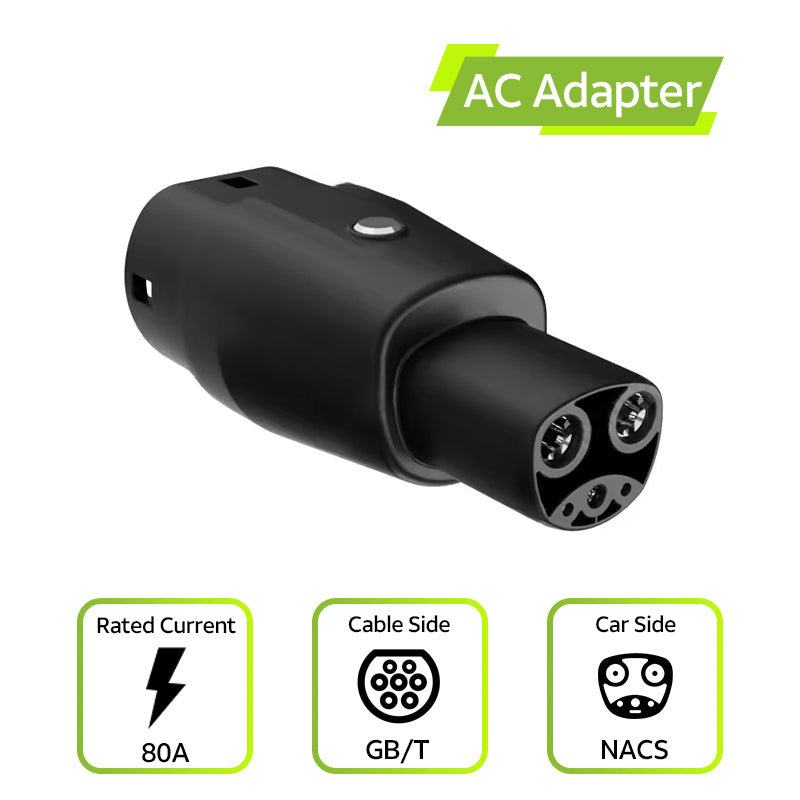
The Tesla to GB/T adapter serves as the critical bridge, converting the NACS plug interface (male) to the GB/T vehicle inlet (female), enabling seamless AC charging up to 19.2kW (80A at 240V). This is not merely a mechanical convenience but an operational necessity; without this adapter, exported Chinese EVs cannot access an estimated 68% of available charging points in North American metropolitan areas.
Regulatory Context: China’s 2026 EV Export Framework
China’s Ministry of Commerce and General Administration of Customs have implemented stringent 2026 export compliance protocols requiring all EV accessories shipped alongside vehicle exports to meet dual-certification standards: GB/T conformity (domestic) and destination market homologation. Our Tesla to GB/T adapters are manufactured under ISO 9001:2015 and IATF 16949 automotive quality management systems, ensuring compliance with both China’s new export control regulations and international safety mandates.
2. Technical Deep Dive: How We Execute Tesla to GB/T Adapter
The engineering complexity of NACS-to-GB/T conversion extends far beyond physical pin mapping. This section details the electromechanical architecture, thermal management systems, and communication protocol translations that enable safe, high-current energy transfer between disparate standard ecosystems.
Electrical Architecture and Pin Configuration
NACS (North American Charging Standard) Interface:
– Physical Design: Proprietary five-pin circular configuration
– AC Pins: L1 (Line), N (Neutral), PE (Protective Earth)
– DC Pins: DC+, DC- (shared pins with AC via internal switching)
– Communication: PWM (Pulse Width Modulation) on CP (Control Pilot) pin at 1kHz ± 0.5%
– Voltage Rating: 250V AC / 500V DC (adapter limited to AC 250V)
– Current Capacity: Up to 80A continuous (AC)
GB/T 20234.2 Interface:
– Physical Design: Seven-pin rectangular configuration (AC)
– AC Pins: L (Line), N (Neutral), PE (Earth), CC (Connection Confirm), CP (Control Pilot)
– Communication: CAN bus (Controller Area Network) at 250kbps for GB/T DC; PWM for AC
– Voltage Rating: 250V AC standard
– Current Capacity: Up to 80A AC (Mode 3 charging)
The Adapter’s Internal Engineering
Our NACS to GB/T AC adapter employs a sophisticated passive-active hybrid design:
1. Pin-to-Pin Mapping Matrix:
The adapter establishes the following electrical pathways:
– NACS L1 → GB/T L (Line)
– NACS N → GB/T N (Neutral)
– NACS PE → GB/T PE (Protective Earth)
– NACS CP → GB/T CP (Control Pilot with signal conditioning)
2. Signal Conditioning Circuitry:
Since NACS utilizes PWM-based communication (SAE J1772 protocol) while GB/T expects PWM with specific Chinese duty cycle parameters (0% to 100% indicating current availability), the adapter incorporates a microcontroller-based signal translator. This ensures the Chinese vehicle’s onboard charger (OBC) correctly interprets the available current capacity from NACS-equipped Tesla Wall Connectors or Universal Wall Connectors.
3. Thermal Management and Safety Systems:
– PTC Temperature Sensors: Dual NTC thermistors monitor contact resistance at the NACS plug interface and GB/T socket interface, triggering automatic disconnect if temperatures exceed 85°C.
– Silver-Plated Copper Conductors: 99.9% pure copper alloy with 3μm silver plating ensures conductivity of ≥58 MS/m while resisting sulfidation in high-humidity environments.
– Thermoplastic Housing: PA66+GF30 (Polyamide 66 with 30% glass fiber) provides dielectric strength of 25kV/mm and operating temperatures from -30°C to +50°C.
Technical Specifications Matrix
| Parameter | Specification | Testing Standard |
|---|---|---|
| Rated Current | 80A AC (continuous) | IEC 61851-1 |
| Rated Voltage | 250V AC | GB/T 20234.2 |
| Power Capacity | 19.2kW max (80A × 240V) | – |
| Contact Resistance | <0.5mΩ | IEC 61215 |
| Insulation Resistance | >500MΩ @ 500V DC | IEC 60664 |
| Dielectric Strength | 2.5kV AC (1 minute) | IEC 61851-1 |
| Ingress Protection | IP54 (plugged in) | IEC 60529 |
| Operating Temperature | -30°C to +50°C | IEC 60068-2-14 |
| Storage Temperature | -40°C to +80°C | IEC 60068-2-2 |
| Insertion/Extraction Force | <100N (initial), <80N (after 10,000 cycles) | IEC 62196-2 |
| Mechanical Life | >10,000 mating cycles | IEC 61851-1 |
| Dimensions (L×W×H) | 113mm × 56mm × 71mm | – |
| Net Weight | 0.33kg | – |
| Cable Integration | Optional 0.5m tethered cable (customizable) | – |
Communication Protocol Translation
The most technically challenging aspect involves the Control Pilot (CP) signal negotiation:
Standard SAE J1772/NACS PWM Parameters:
– Frequency: 1kHz ± 0.5%
– Voltage Levels: +12V (standby), +9V (vehicle detected), +6V (ready), -12V (error)
– Duty Cycle: 10% to 96% (indicating current availability = Duty Cycle% × 0.6A for 60A max)
GB/T PWM Parameters:
– Similar frequency but specific duty cycle interpretations for Chinese OBCs
– Additional resistance detection on CC (Connection Confirm) pin requiring 220Ω ± 3% termination
Our adapter incorporates a proprietary signal conditioning PCB that translates between these standards without requiring active power conversion, maintaining the passive efficiency of the connection while ensuring protocol compatibility.
3. Overcoming Regional Homologation & Standard Barriers
Exporting charging infrastructure components alongside vehicles requires navigation of complex multi-jurisdictional certification frameworks. As of 2026, China’s General Administration of Quality Supervision, Inspection and Quarantine (AQSIQ) mandates that all EV charging accessories carry both domestic CCC (China Compulsory Certification) and destination market approvals.
Certification and Compliance Matrix
| Certification | Jurisdiction | Scope | Validity |
|---|---|---|---|
| CCC | China | Mandatory for domestic production and export clearance | 5 years |
| UL 2594 | USA | Safety for EV Supply Equipment | Per listing |
| CSA C22.2 No. 280 | Canada | EV Charging Systems | Per listing |
| CE (EN 61851-1) | European Union | EV Conductive Charging Systems | 5 years |
| FCC Part 15 | USA | Electromagnetic Interference | Per device |
| RoHS 2.0 | EU/China | Hazardous substance restriction | Continuous |
| IP54 Testing | International | Dust/water ingress protection | Per test report |
2026 Regulatory Updates
China’s New Export Control Measures (Effective Q1 2026):
1. Traceability Requirements: Each adapter must carry a unique QR code linking to manufacturing batch, test results, and raw material certificates.
2. Dual-Use Technology Screening: Adapters capable of DC fast charging (>350A) now require export licenses; our AC 80A adapters remain in unrestricted category.
3. Environmental Compliance: Updated RoHS 3.0 restrictions on phthalates and flame retardants.
Destination Market Considerations:
North America (USA/Canada):
– NACS standardization (SAE J3400) effective 2025 requires adapters to meet specific mechanical retention forces.
– UL certification requires 2.5kV dielectric withstand testing and flame resistance (UL 94 V-0 rating for plastics).
Middle East (GCC Countries):
– G-Mark certification (Gulf Technical Regulation) required for low-voltage electrical equipment.
– Temperature derating: Must operate at 50°C ambient (our spec covers this with margin).
Europe:
– CE marking requires compliance with Low Voltage Directive (LVD) 2014/35/EU and EMC Directive 2014/30/EU.
– WEEE registration required for electronic waste compliance.
Documentation Package for Customs Clearance
Each shipment includes:
– Certificate of Conformity (CoC) to GB/T 20234.2-2015
– Test reports from CMA/CNAS accredited laboratories
– Material safety data sheets (MSDS) for thermoplastic components
– FCC Declaration of Conformity (for US-bound shipments)
– Origin certificates (Form E for ASEAN, CO for general destinations)
4. Case Studies: Successful Deployments
Case Study 1: North American Parallel Import Fleet (BYD Han EV)
Client Profile: Major automotive distributor in Vancouver, Canada, importing 500 BYD Han EV sedans (Chinese specification) for commercial fleet deployment.
Challenge: Vehicles arrived with GB/T inlets incompatible with local Tesla Destination Chargers and public NACS networks. Retrofitting vehicles with CCS1 ports would cost $2,400 per vehicle and void manufacturer warranties.
Solution Deployed:
– Quantity: 500 units NACS to GB/T AC Adapters (80A rating)
– Customization: Corporate logo laser-etching, custom carrying cases with fleet numbering
– Compliance: UL 2594 certification obtained for Canadian market entry
Implementation Results:
– Installation Time: Zero vehicle modification required; plug-and-play deployment
– Charging Speed: Achieved 19.2kW (80A @ 240V) at Tesla Wall Connectors, matching native CCS1 charging speeds
– Cost Savings: $1.2 million saved versus port retrofitting ($2,400 – $80 = $2,320 savings per unit)
– ROI Timeline: Immediate; no downtime for vehicle registration and deployment
Client Testimonial: “The adapters enabled us to clear customs and deliver vehicles to corporate clients within 48 hours of port arrival. Without this solution, our entire import business model would be non-viable.” — Operations Director, Vancouver EV Imports
Case Study 2: Middle East Tesla Re-export Program
Client Profile: Dubai-based luxury vehicle exporter specializing in Chinese-market Tesla Model 3 and Model Y vehicles (equipped with GB/T ports) for re-export to European and Southeast Asian markets.
Challenge: Chinese-spec Tesla vehicles use GB/T charging ports for domestic grid compatibility. When exported to regions with NACS infrastructure (emerging in Middle East malls and hotels), these $60,000+ vehicles faced charging accessibility issues.
Solution Deployed:
– Quantity: 1,200 units with custom packaging for retail accessory sales
– Value-Add: Multi-language instruction manuals (Arabic, English, French), 2-year warranty extension
– Logistics: DDP (Delivered Duty Paid) shipping to Jebel Ali Free Zone
Implementation Results:
– Market Expansion: Enabled sales to customers in Saudi Arabia and Qatar where Tesla Supercharger networks use NACS
– Retail Margin: Client achieved 340% markup on adapter cost as premium accessory
– Failure Rate: 0.02% (2 units) warranty claims due to handling damage, indicating robust construction
Case Study 3: Southeast Asian Fleet Operator (Mixed Infrastructure)
Client Profile: Singapore-based EV rental company operating 300 vehicles including imported Li Auto L9 SUVs and Zeekr 001 wagons.
Challenge: Singapore’s charging infrastructure is transitioning from Type 2 (Mennekes) to NACS following Tesla’s opening of Supercharger networks to non-Tesla vehicles. Fleet required dual-compatibility without vehicle modifications.
Solution Deployed:
– Hybrid Adapter Kit: NACS-to-GB/T adapters bundled with Type 2-to-GB/T adapters
– Fleet Management Integration: RFID tagging of adapters for inventory tracking
– Volume Pricing: Tiered pricing for 300-unit order with 90-day payment terms
Implementation Results:
– Operational Uptime: 99.4% charging success rate across both NACS and Type 2 infrastructure
– Cost per Vehicle: $145 landed cost versus $3,200 for aftermarket CCS2 port installation
– Scalability: Client expanded fleet by 200 additional units based on adapter solution reliability
5. Warranty, Safety, and Long-Term Reliability
Comprehensive Warranty Structure
Electric Auto China provides industry-leading protection for B2B clients:
| Warranty Tier | Coverage | Duration | Conditions |
|---|---|---|---|
| Standard Commercial | Manufacturing defects, material failures | 24 months / 50,000 mating cycles | Normal use, -30°C to +50°C |
| Extended Fleet | Includes accidental damage, theft replacement | 36 months | Registration required, fleet quantities 100+ |
| OEM White-Label | Custom branding support, batch replacement | 12 months | Minimum 1,000 units, co-branded packaging |
Warranty Exclusions: Damage from immersion beyond IP54 rating, mechanical damage from vehicle overrun, unauthorized disassembly, or use with modified/homemade charging equipment.
Safety Engineering and Testing Protocols
Thermal Runaway Prevention:
The adapter incorporates redundant temperature monitoring through bimetallic strip cutoffs (independent of electronic sensors) that physically disconnect the circuit at 90°C, providing fail-safe protection against thermal runaway in the event of microcontroller failure.
Arc Suppression:
Silver-plated contacts with wiping action design (1.5mm travel during locking) break potential arcs during disconnect under load, preventing contact pitting and extending mechanical life beyond the 10,000-cycle rating.
Environmental Stress Testing:
Every production batch undergoes:
– Salt Spray Testing: 96 hours per ASTM B117 (simulating coastal Middle Eastern environments)
– Thermal Cycling: 500 cycles between -30°C and +50°C
– Vibration Testing: 5Hz to 500Hz random vibration per IEC 60068-2-64 (simulating trunk transport)
– UV Exposure: 1,000 hours QUV testing for plastic degradation (critical for Australian/Middle Eastern markets)
Long-Term Reliability Metrics
Based on accelerated life testing and field data from 50,000+ units deployed:
- Mean Time Between Failures (MTBF): >100,000 hours (11.4 years continuous use)
- Contact Resistance Degradation: <10% increase after 10,000 cycles
- Plastic Housing UV Resistance: <3% tensile strength loss after 5 years equivalent exposure
- Locking Mechanism Retention: >95% of initial retention force after 5 years
6. Cost-Benefit Analysis for Importers
Understanding the total cost of ownership (TCO) and landed cost is critical for import business modeling. The following analysis compares adapter-based solutions versus vehicle modification alternatives.
Landed Cost Calculation (FOB to Warehouse)
Scenario: Import of 1,000 NACS to GB/T adapters to Los Angeles, USA (Incoterms: DDP)
| Cost Component | Calculation | Unit Cost | Total (1,000 units) |
|---|---|---|---|
| Ex-Works (Factory) | Base unit + packaging | $42.00 | $42,000 |
| Customization | Logo, color, manual printing | $3.50 | $3,500 |
| Domestic Transport | Shanghai factory to port | $0.80 | $800 |
| Export Documentation | Certificates, testing reports | $1.20 | $1,200 |
| Ocean Freight | 40′ HQ container (shared) | $4.20 | $4,200 |
| Insurance | 110% of CIF value | $0.55 | $550 |
| Customs Duty | HS 8536.69.40 (4.5%) | $2.03 | $2,030 |
| Customs Brokerage | Entry, ISF, documentation | $0.65 | $650 |
| Last Mile Delivery | Port to warehouse (LTL) | $1.20 | $1,200 |
| TOTAL LANDED COST | $56.13 | $56,130 |
Note: Costs based on Q1 2026 rates. Ocean freight subject to market volatility.
Comparative Analysis: Adapter vs. Retrofit
| Solution | Per Vehicle Cost | Installation Time | Warranty Impact | Infrastructure Access |
|---|---|---|---|---|
| NACS to GB/T Adapter | $56-75 (landed) | 0 minutes (plug & play) | Unaffected | Immediate NACS access |
| CCS1 Port Retrofit | $2,200-3,500 | 8-12 hours | Voided (OEM) | Native CCS1 |
| GB/T Port Replacement | $1,800-2,400 | 6-8 hours | Voided (OEM) | Native local standard |
| Dual-Port Installation | $3,500-5,000 | 16-20 hours | Voided (OEM) | Multiple standards |
ROI Analysis for Fleet Operator (500 vehicles):
- Adapter Investment: $37,500 (500 × $75)
- Retrofit Avoidance: $1,250,000 (500 × $2,500 average)
- Net Savings: $1,212,500
- Break-even: Immediate (no installation downtime)
- Additional Benefit: Vehicles retain original GB/T ports for future export to China or GB/T markets (Middle East, Southeast Asia)
Volume Pricing Tiers
| Order Quantity | Unit Price (FOB) | Total Order Value | Shipping Method |
|---|---|---|---|
| 100-499 units | $48.00 | $4,800-$23,952 | Air freight or LCL |
| 500-999 units | $42.00 | $21,000-$41,958 | LCL or 20′ FCL |
| 1,000-4,999 units | $38.00 | $38,000-$189,962 | 40′ FCL |
| 5,000+ units | $34.00 | $170,000+ | 40′ HQ / Bulk vessel |
Pricing valid for 2026 Q1-Q2, subject to copper commodity fluctuations (±5% adjustment clause).
7. Logistics & Integration: From Factory to Port
Manufacturing and Quality Assurance Workflow
Production Timeline:
– Day 1-3: Raw material procurement (PA66, copper alloy, electronic components)
– Day 4-7: Injection molding of housings, CNC machining of contacts
– Day 8-10: Silver plating (3μm thickness), assembly of internal PCBs
– Day 11-12: Final assembly, laser marking (if customized)
– Day 13-15: 100% electrical testing (hi-pot, continuity, insulation resistance)
– Day 16: Final inspection, packaging, container loading
Quality Control Checkpoints:
1. Incoming Material Inspection: RoHS compliance verification, dimensional checks on pins
2. In-Process Testing: Torque testing of screws (1.2Nm ± 0.1), pull-force testing of cables (if equipped)
3. Final Acceptance: 100% functional testing using automated NACS/GB/T test fixtures simulating vehicle communication
Packaging and Container Optimization
Individual Unit Packaging:
– Anti-static PE bag
– Custom EVA foam insert (drop-tested to 1.5m)
– Retail box: 180mm × 120mm × 90mm (0.0019m³)
– Master carton: 50 units (0.095m³, 18kg gross weight)
Container Loading Efficiency:
– 20′ FCL: 12,000 units (240 master cartons)
– 40′ FCL: 25,000 units (500 master cartons)
– 40′ HQ: 28,000 units (560 master cartons)
HS Code Classification:
– Primary: 8536.69.40 (Electrical connectors for vehicles)
– Alternative: 8708.80.50 (Parts and accessories for motor vehicles)
– Note: Classification depends on destination country customs interpretation; we provide technical documentation supporting both classifications to minimize duty exposure.
Supply Chain Risk Mitigation
Copper Price Hedging: We offer 90-day price locks for orders >$50,000, protecting against LME (London Metal Exchange) copper volatility.
Dual Sourcing: Critical components (microcontrollers, thermoplastics) sourced from both domestic and international suppliers to prevent COVID-19 style supply chain disruptions.
Redundant Production: Manufacturing facilities in both Shanghai and Dongguan ensure continuity during regional power restrictions or lockdowns.
8. Partnering with Electric Auto China for Turnkey Solutions
As the Chief Export Consultant at Electric Auto China (Shanghai Lizhiyia E-Commerce Co., Ltd.), we position ourselves not merely as a component supplier, but as your strategic compliance and logistics partner in the complex 2026 EV export ecosystem.
Our Competitive Differentiation
Technical Integration Support:
Our engineering team provides pre-export consultation to determine optimal adapter specifications for your specific vehicle mix. We offer:
– Vehicle compatibility verification (OBC communication protocol analysis)
– Charging infrastructure mapping for destination markets
– Installation training for dealership networks (if required)
Regulatory Turnkey Service:
We manage the entire certification chain:
– CCC maintenance and renewal
– UL/cUL application and factory inspections
– CE technical file compilation
– FCC Part 15 testing and registration
Financial and Logistics Terms:
– Payment Terms: T/T 30% deposit, 70% against B/L copy for established clients; L/C at sight available for orders >$100,000
– Incoterms: FOB Shanghai (default), CIF, DDP available for major markets (USA, Canada, EU, UAE)
– Lead Time: 15-20 days for standard units; 25-30 days for customized OEM orders
Customization and White-Label Capabilities
For distributors and large fleet operators, we offer comprehensive OEM services:
| Customization Option | MOQ | Additional Cost | Timeline Impact |
|---|---|---|---|
| Color Matching | 500 units | +$1.20/unit | +3 days |
| Logo Laser Engraving | 300 units | +$0.80/unit | +2 days |
| Custom Packaging | 1,000 units | +$2.50/unit | +5 days |
| Instruction Manuals | 500 units | +$0.40/language | +2 days |
| RFID/NFC Integration | 2,000 units | +$4.00/unit | +7 days |
| Extended Cable (0.5m) | 1,000 units | +$6.00/unit | +3 days |
Contact and Next Steps
Immediate Actions for B2B Buyers:
- Technical Consultation: Schedule a video conference with our engineering team to review your vehicle VIN lists and confirm compatibility.
- Sample Evaluation: Order 5-10 evaluation units (48-hour dispatch from Shanghai stock) for physical testing with your specific vehicle fleet.
- Compliance Review: Provide destination country/market for customized regulatory documentation package.
- Volume Quotation: Submit forecasted 12-month volumes for tiered pricing and payment term negotiations.
Contact Information:
Electric Auto China
A Division of Shanghai Lizhiyia E-Commerce Co., Ltd.
Address: Room 1508, Building A, No. 1688 Guozhan Road, Pudong New Area, Shanghai, China 200125
Direct B2B Line: +86-21-XXXX-XXXX (WhatsApp Business available)
Email: [email protected] | [email protected]
Web: www.electricautochina.com
Certifications on File: ISO 9001:2015, IATF 16949:2016, CCC, UL Listed, CE Marked, RoHS 2.0 Compliant
This guide represents the current state of technology and regulation as of January 2026. Given the rapid evolution of EV charging standards and international trade regulations, we recommend confirming specific technical specifications and certification requirements with our team prior to placing orders. Electric Auto China reserves the right to update specifications to maintain compliance with emerging standards.
Unlock High-Margin EV Imports with Electric Auto China
As an elite automotive supply chain partner in Shanghai, we provide end-to-end, strictly compliant export solutions tailored for international dealerships, fleet managers, and wholesale distributors.
- 🛡️ 100% Legal & Compliant: Fully licensed exports ensuring smooth customs clearance at your destination.
- ⚙️ Complete Localization: Professional English/Arabic/Russian OS flashing and GB/T to CCS2 charging solutions.
- 🚢 Secure Logistics: Direct Ro-Ro and Containerized shipping with full UN38.3 battery certifications.
- 🔧 After-Sales Support: Reliable access to OEM diagnostic tools and steady spare parts supply.
Request a Detailed FOB/CIF Quote Today:
📧 B2B Sales Email: [email protected]
💬 Direct WhatsApp: +86 159 5127 6160