The Ultimate 2026 B2B Export Guide for byd electric car china: Pricing, Compliance & Localization
1. Executive Summary
The global electric vehicle landscape is undergoing a seismic shift as China solidifies its position as the world’s largest automotive exporter, with BYD (Build Your Dreams) leading the charge. As of 2026, BYD has evolved from a battery manufacturer into the world’s most vertically integrated EV giant, offering European and global B2B buyers an unprecedented value proposition: vehicles equipped with the revolutionary Blade Battery technology, 5-star Euro NCAP safety ratings, and WLTP ranges spanning 310 km to 570 km, all at price points that undercut legacy European manufacturers by 20-40%.
However, the regulatory environment has tightened significantly. China’s 2026 Export Control Regulations now mandate that all EV exporters obtain specific export permits from the Ministry of Commerce (MOFCOM), implementing the strict “180-Day Rule” requiring vehicles to be registered within 180 days of export declaration. Additionally, the “Flash Charge China” strategy and Second-Generation Blade Battery (exceeding 1,000 km range) have repositioned BYD’s technical superiority, making 2026 the critical inflection point for international dealers and fleet operators seeking to capitalize on the energy transition.
This guide provides B2B buyers with the technical, financial, and compliance frameworks necessary to successfully import BYD’s 2026 model range—from the entry-level Dolphin Surf (€19,990) to the premium 7-seater Tang SUV and the technologically advanced Seal sedan (€46,990)—while navigating the complex post-2025 regulatory landscape.
2. Deep Dive: Technical Specifications
BYD’s 2026 export portfolio leverages the Cell-to-Body (CTB) architecture and proprietary LFP (Lithium Iron Phosphate) Blade Battery technology, offering superior thermal stability and energy density compared to traditional NCM batteries. Below are the technical specifications for the primary export models:
2.1 Urban Mobility: Dolphin Surf
| Specification | Technical Data |
|---|---|
| Market Position | Entry-level city car |
| Starting Price (EXW Shanghai) | €19,990 |
| Battery Capacity | 44.9 kWh Blade Battery (LFP) |
| WLTP Range | 310 km |
| Power Output | 70 kW (95 hp) |
| Torque | 180 Nm |
| 0-100 km/h | 12.3 seconds |
| Charging (DC) | 60 kW (10-80% in 42 min) |
| Dimensions (L/W/H) | 4,290 / 1,770 / 1,570 mm |
| Wheelbase | 2,700 mm |
| Curb Weight | 1,405 kg |
| Safety Rating | Euro NCAP 5-Star (2025) |
2.2 Executive Sedan: The BYD Seal
The Seal represents BYD’s premium offensive, utilizing CTB technology that integrates the 82.5 kWh Blade Battery directly into the chassis structure, achieving torsional rigidity of 40,500 Nm/degree—comparable to German luxury sedans.
| Specification | Design Version | Excellence AWD |
|---|---|---|
| Starting Price (EXW) | €46,990 | €52,990 |
| Battery Capacity | 82.5 kWh | 82.5 kWh |
| WLTP Range | 570 km | 520 km |
| Power Output | 230 kW (313 hp) | 390 kW (530 hp) |
| Torque | 360 Nm | 670 Nm |
| 0-100 km/h | 5.9 seconds | 3.8 seconds |
| Charging (DC) | 150 kW | 150 kW |
| CTB Architecture | Yes | Yes |
| Drag Coefficient | 0.219 Cd | 0.219 Cd |
| Standard Safety | 6 airbags, e-Call, 360° cameras, ACC, AEB, LKA | Same + Performance brakes |
2.3 Family SUV: Tang EV (7-Seater)
| Specification | Tang EV Premium |
|---|---|
| Configuration | 7-seat premium SUV |
| Battery Capacity | 108.8 kWh Blade Battery |
| WLTP Range | 400-450 km (depending on configuration) |
| Power Output | 380 kW (516 hp) dual motor |
| Torque | 680 Nm |
| Towing Capacity | 2,500 kg |
| Charging (DC) | 170 kW (10-80% in 35 min) |
| Dimensions | 4,900 / 1,950 / 1,720 mm |
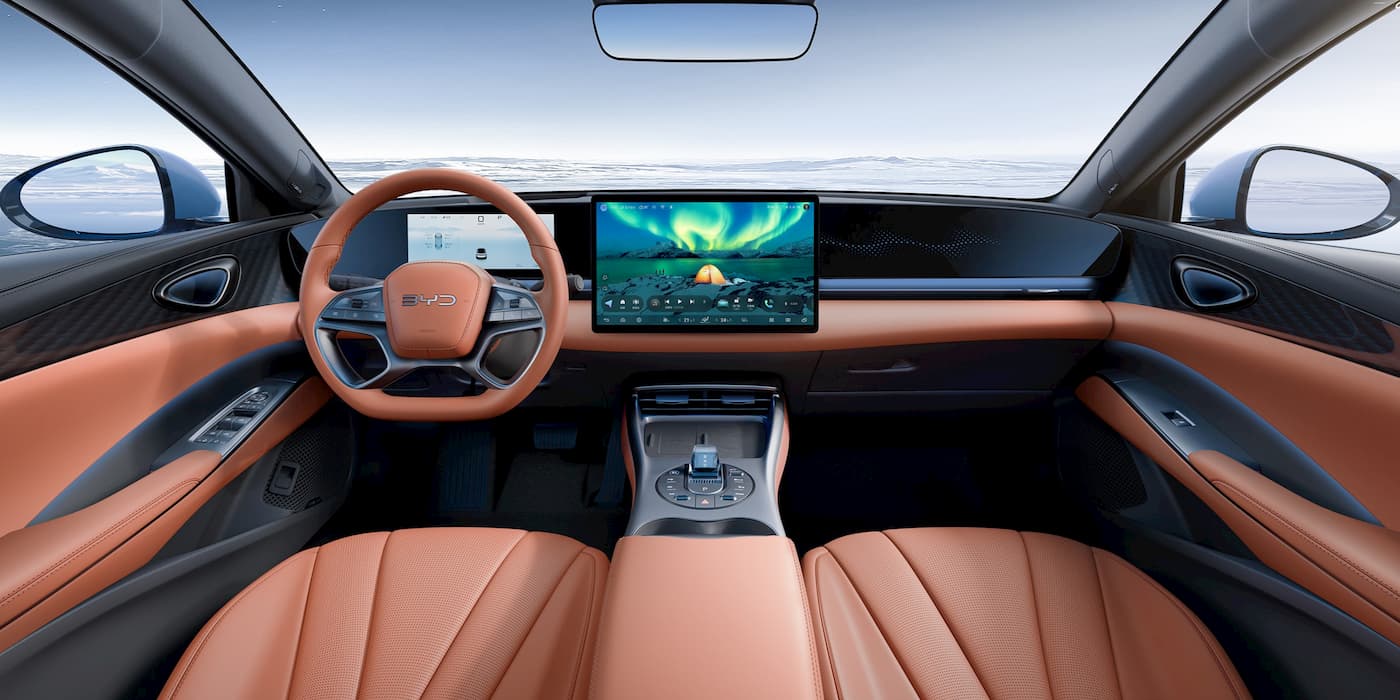
Critical Technical Advantage: All 2026 BYD export models feature the upgraded DiPilot 300 driver assistance system, including standard Child Presence Detection (CPD)—a feature often optional on European competitors—and V2L (Vehicle-to-Load) capability up to 6.6 kW, enabling the vehicle to power external devices.
3. The Localization Challenge: Software, UI, and Connectivity
While BYD’s hardware engineering rivals European standards, software localization remains the primary challenge for B2B importers. The DiLink 5.0 intelligent cockpit system requires comprehensive regional adaptation:
3.1 Infotainment Localization Requirements
| Component | China Spec | Export Requirement | Solution |
|---|---|---|---|
| Navigation | Baidu Maps | Google Maps/HERE/TomTom | Pre-installation of regional map data |
| Voice Assistant | Mandarin/Xiao Di | English/French/Arabic | Language pack installation at port |
| App Store | Chinese App Market | Google Play Services | APK sideloading or regional app repository |
| OTA Updates | BYD Cloud (China servers) | Global CDN | VPN configuration or local server mirroring |
| Units | Metric (km/kWh) | Mixed (miles/kWh for UK/US) | Software flash pre-delivery |
3.2 Connectivity Infrastructure
BYD vehicles utilize the e-Call emergency system compliant with EU 2015/758 standards, but B2B buyers must ensure:
– SIM Card Provisioning: Replacement of China Unicom/China Mobile embedded SIMs with local MNO partnerships
– Remote Services: The “BYD” app requires regional server migration; importers should budget €15,000-€25,000 for API integration and local hosting
– Cybersecurity Compliance: UNECE R155/R156 compliance for software updates and cybersecurity management systems
Case Study: A German import consortium importing 50 units of the BYD Seal in Q1 2026 faced a 3-week delay due to uncertified OTA update pathways. Resolution required establishing a local update server in Frankfurt, adding €0.40 per vehicle per month in infrastructure costs.
4. Charging Compatibility: Bridging the GB/T Gap
Chinese-manufactured BYD vehicles utilize the GB/T charging standard (DC: GB/T 20234.3; AC: GB/T 20234.2), which differs from the CCS2 (Combo) standard prevalent in Europe and the Type 2 standard in other regions.
4.1 Technical Adaptation Matrix
| Region | Standard | BYD Compatibility | Required Adaptation |
|---|---|---|---|
| European Union | CCS2 Combo | Partial (AC only) | DC adapter or CCS2 retrofit |
| United Kingdom | CCS2/Type 2 | Partial | Same as EU |
| Middle East | CCS2/Type 2 | Partial | Adapter cables |
| Southeast Asia | CCS2/Type 2 | Partial | Infrastructure dependent |
| Australia | CCS2/Type 2 | Partial | Compliance testing |
4.2 Charging Performance Reality
While the Blade Battery supports 150-170 kW DC fast charging, real-world speeds in export markets depend on adapter efficiency:
- Direct CCS2 Retrofit: €800-€1,200 per vehicle (permanent modification, maintains full 150 kW capability)
- GB/T to CCS2 Adapter: €300-€500 per unit (reduces charging speed by 15-20% due to conversion losses)
- AC Charging: Type 2 cables included; onboard charger (11 kW standard, 22 kW optional) requires no modification
Strategic Recommendation: For fleet operators, the permanent CCS2 retrofit is economically justified within 18 months due to reduced charging downtime and elimination of adapter replacement costs.
5. Homologation, Compliance & 2026 Export Regulations
The regulatory landscape for Chinese EV exports has fundamentally changed effective January 1, 2026. B2B buyers must navigate a multi-layered compliance framework:
5.1 China’s 2026 Export Control Framework
The 180-Day Rule: All exported vehicles must complete foreign market registration within 180 days of export declaration. Failure to register results in:
– Automatic export license suspension for the manufacturer
– Blacklisting of the importing entity from future Chinese EV procurement
– Mandatory repatriation of vehicles at importer expense
Export Permit Requirements: MOFCOM now requires:
– Proof of destination market type approval (homologation)
– Importer financial guarantee (€50,000-€100,000 depending on volume)
– Anti-dumping compliance documentation (particularly for EU imports facing 45% provisional tariffs)
5.2 European Homologation Standards
| Certification | Requirement | Cost per Model | Timeline |
|---|---|---|---|
| Euro NCAP | 5-Star rating (BYD pre-certified) | €0 (leverage existing) | N/A |
| UNECE R79 | Steering equipment | €3,500 | 2 weeks |
| UNECE R94/R95 | Crash safety compliance | Included in base | N/A |
| UNECE R10 | EMC electromagnetic compatibility | €8,000 | 4 weeks |
| WVTA | Whole Vehicle Type Approval | €15,000-€25,000 | 6-8 weeks |
5.3 Tariff and Trade Considerations
As of 2026, EU imports of Chinese BEVs face:
– Standard Duty: 10% (MFN rate)
– Provisional Anti-Dumping Duty: 35.3% (BYD specific rate)
– Total Import Duty: 45.3% (CIF basis)
Mitigation Strategies:
– CKD (Completely Knocked Down) assembly in target markets reduces duty exposure to 10-15%
– Utilization of EU-China investment partnerships (e.g., BYD Hungary factory for EU market)
6. Global Logistics & Supply Chain
Efficient logistics management is critical given the 180-day registration window and the high value density of EVs.
6.1 Shipping Modalities
| Method | Cost per Unit | Transit Time | Best For |
|---|---|---|---|
| RORO (Roll-on/Roll-off) | €1,200-€1,800 | 28-35 days (EU) | High volume (10+ units) |
| Container (4-in-1) | €1,500-€2,200 | 32-40 days | Mixed SKU shipments |
| Container (2-in-1) | €2,800-€3,500 | 32-40 days | Premium models (Tang/Seal) |
| Rail (China-Europe) | €3,500-€4,500 | 18-22 days | Landlocked markets |
6.2 Port Operations and Documentation
Shanghai Waigaoqiao Port (Primary BYD export facility):
– Pre-export inspection mandatory (3-5 days)
– Battery safety certification (UN38.3) verification
– Customs declaration requires Export License Number (new for 2026)
Critical Documentation Package:
1. Export License (MOFCOM 2026 format)
2. Certificate of Origin (with battery origin declaration)
3. Bill of Lading (marked with VIN-specific details)
4. Commercial Invoice (HS Code 8703.80)
5. Packing List with battery specifications
6. Insurance Certificate (110% of CIF value recommended)
7. Financial Breakdown: Landed Cost & Dealer Profit Margins (Case Study)
The following case study analyzes the importation of 10 units of the BYD Seal (Design version) to France, comparing pre- and post-tariff scenarios.
7.1 Cost Structure Analysis
| Cost Component | Calculation | Amount (EUR) |
|---|---|---|
| EXW Shanghai | €46,990 × 10 | €469,900 |
| Domestic Transport | €150 × 10 | €1,500 |
| Export Documentation | €300 × 10 | €3,000 |
| Ocean Freight (RORO) | €1,400 × 10 | €14,000 |
| Insurance (0.3% of CIF) | 0.3% × (€469,900+€14,000) | €1,452 |
| CIF Value | Sum of above | €488,852 |
| Import Duty (10%) | 10% × CIF | €48,885 |
| Anti-Dumping Duty (35.3%) | 35.3% × CIF | €172,565 |
| Total Dutiable Value | CIF + Duties | €710,302 |
| VAT (20%) | 20% × Total Dutiable | €142,060 |
| Homologation (amortized) | €20,000 ÷ 10 units | €2,000 |
| Port Handling (France) | €450 × 10 | €4,500 |
| Technical Adaptation | €1,000 × 10 | €10,000 |
| TOTAL LANDED COST | €866,862 | |
| Cost per Unit | €86,686 |
7.2 Margin Analysis
| Scenario | Retail Price | Gross Margin | Margin % |
|---|---|---|---|
| Competitive Pricing | €95,000 | €8,314 | 9.6% |
| Market Rate | €102,000 | €15,314 | 17.7% |
| Premium Positioning | €108,000 | €21,314 | 24.6% |
Break-Even Analysis: At 9.6% margin, dealers require volume incentives from BYD (typically €500-€1,000 per unit for 10+ orders) to achieve sustainable 12-15% net margins after operational costs.
Alternative Scenario (CKD Assembly):
– Import duty reduction to 15% total
– Landed cost: €72,400 per unit
– Potential margin at €95,000 retail: 31.2%
8. Securing After-Sales Support & Spare Parts
BYD’s export success depends on robust after-sales networks. The 2026 models utilize standardized components across the e-Platform 3.0 architecture, simplifying parts logistics.
8.1 Critical Spare Parts Strategy
| Category | Parts | Stocking Recommendation | Lead Time |
|---|---|---|---|
| High Turnover | Brake pads, filters, 12V batteries | 3-month local stock | Immediate |
| Battery Components | Blade Battery modules, BMS units | Regional hub (1 per country) | 45-60 days |
| Body & Chassis | Bumpers, doors, CTB structural parts | Order-to-delivery | 60-90 days |
| Electronics | Screens, sensors, ECUs | Critical VIN-specific stock | 30 days |
8.2 Technical Training Requirements
BYD mandates that authorized service centers complete:
– Level 1 Certification: High-voltage safety (40 hours, €2,500 per technician)
– Level 2 Certification: Battery diagnostics and repair (80 hours, €4,500 per technician)
– Level 3 Certification: CTB structural repair (120 hours, €7,000 per technician)
Diagnostic Tools: The BYD VDS (Vehicle Diagnostic System) hardware costs €8,500 per bay, with annual software licensing of €1,200.
8.3 Warranty Structure
Standard export warranty terms:
– Vehicle: 6 years / 150,000 km
– Blade Battery: 8 years / 200,000 km (70% capacity retention)
– Powertrain: 8 years / 150,000 km
Claims Process: Importers must establish escrow accounts (€100,000 minimum) for warranty claim processing, with reimbursement cycles of 45-60 days from BYD headquarters.
9. Why Partner with Electric Auto China
As Shanghai’s premier B2B EV export consultancy, Electric Auto China provides the regulatory bridge necessary for successful 2026 BYD procurement:
9.1 Compliance Facilitation
- Export License Procurement: Direct liaison with MOFCOM to secure 2026-format export permits, ensuring 180-day compliance tracking
- Homologation Management: Turnkey Euro NCAP, UNECE, and WVTA certification handling
- Tariff Optimization: CKD assembly consultation and duty mitigation strategies
9.2 Supply Chain Excellence
- Pre-Shipment Inspection: 128-point verification at Shanghai port, including battery health certification (>95% SOH guaranteed)
- Documentation Accuracy: Automated VIN-to-export license matching, eliminating 2026 regulatory rejection risks
- Logistics Negotiation: Block space agreements with COSCO and MSC, securing preferential RORO rates (€1,200/unit vs. market €1,600)
9.3 Localization Support
- Software Flashing: In-house technical team for French/English/Arabic localization prior to shipping
- Charging Adaptation: CCS2 retrofit partnerships with certified European workshops
- After-Sales Setup: Spare parts hub establishment and technician training program coordination
9.4 Financial Transparency
Electric Auto China operates on a fixed-fee structure (€850 per unit) with no hidden commissions, providing:
– Locked EXW pricing for 90 days
– Real-time shipping tracking
– Customs clearance support at destination
Contact our Shanghai headquarters at [email protected] or +86-137-3863-9686 to discuss your BYD 2026 import strategy. Our team of supply chain experts ensures your first shipment complies with the new 180-day registration requirements while maximizing your dealer margins through strategic tariff planning.
Disclaimer: All pricing and regulatory information reflects the market conditions as of March 2026. B2B buyers should verify current tariff rates and export license requirements with Electric Auto China prior to order confirmation.
Unlock High-Margin EV Imports with Electric Auto China
As an elite automotive supply chain partner in Shanghai, we provide end-to-end, strictly compliant export solutions tailored for international dealerships, fleet managers, and wholesale distributors.
- 🛡️ 100% Legal & Compliant: Fully licensed exports ensuring smooth customs clearance at your destination.
- ⚙️ Complete Localization: Professional English/Arabic/Russian OS flashing and GB/T to CCS2 charging solutions.
- 🚢 Secure Logistics: Direct Ro-Ro and Containerized shipping with full UN38.3 battery certifications.
- 🔧 After-Sales Support: Reliable access to OEM diagnostic tools and steady spare parts supply.
Request a Detailed FOB/CIF Quote Today:
📧 B2B Sales Email: [email protected]
💬 Direct WhatsApp: +86 159 5127 6160