The Ultimate 2026 Importer’s Guide to Reliable China car agent
1. The Macro-Economics of Reliable China car agent in 2026

As we enter 2026, China’s automotive export ecosystem has undergone a fundamental structural transformation. The era of opportunistic, price-driven vehicle trading has given way to a highly regulated, compliance-intensive environment where only accredited entities can participate. For international B2B buyers, understanding this macro-economic shift is the first step toward identifying a reliable China car agent capable of delivering sustainable value.
The Scale of Opportunity
China’s logistics and supply chain market now exceeds 350 trillion yuan in total value, representing a 6.5% year-on-year increase that underscores the sector’s remarkable resilience. Within this ecosystem, automotive exports have emerged as a structural growth pillar rather than a cyclical outlet. According to Automobility data, China closed 2025 with record vehicle exports of approximately 7.1 million units, while domestic NEV (New Energy Vehicle) shipments hit 16.5 million units—a 28.2% increase that firmly establishes electrification as the market’s primary growth engine.
This export volume is no longer concentrated in single markets. The IEA’s latest analysis confirms that China’s EV export growth is becoming geographically diversified and policy-aware, with expanding footprints across the Middle East, South America, Africa, and Southeast Asia. For European and global importers, this diversification creates both opportunity and complexity: opportunity in accessing cutting-edge EV technology at scale, and complexity in navigating multi-regional production networks that blend Chinese inputs with Southeast Asian assembly and European final customization.
The “New Development Landscape” (NDL) Three-Pillar Framework
The 2026 sourcing environment is defined by three major developments that reshape how importers must evaluate potential agents:
Product Value Upgrading: China’s export portfolio has shifted decisively toward high-value categories—electric vehicles, renewable energy equipment, advanced batteries, and sophisticated electronics. This means your China car agent must possess technical competency far beyond traditional trading. They must understand battery chemistry variations (LFP vs. NCM), OTA (Over-The-Air) update capabilities, and integrated supply chain traceability.
Multi-Regional Production Networks: The “China Plus One” strategy has evolved into blended supply models. Reliable agents now coordinate manufacturing across Chinese component hubs, Southeast Asian assembly facilities (particularly Thailand and Indonesia), and European final customization centers. This reduces geopolitical concentration risk but requires agents with transnational compliance capabilities and multi-currency operational expertise.
Regulatory Alignment Pressure: European sustainability regulations—specifically carbon disclosure requirements, packaging directives, and supply chain due diligence laws—now influence logistics decisions at origin. Your agent must provide compliant documentation including battery carbon footprints, recycled content certificates, and ethical sourcing attestations. Green logistics has transitioned from concept to mandate, with China’s dual carbon goals driving policy: electric vehicles now constitute over 35% of urban delivery fleets, while solar-powered warehouses and carbon-neutral shipping options have become standard offerings.
Market Dynamics and Volume Projections
Despite projections of stagnant domestic car sales in 2026 (potentially flat growth extending recent downtrends), export momentum continues. Industry analysts forecast China could export up to 10 million electric cars annually within five years. However, the composition is shifting: while BEV (Battery Electric Vehicle) exports face tariff headwinds in certain markets, plug-in hybrid exports tripled in 2025 and are estimated to remain strong through 2026.
This creates a bifurcated sourcing strategy. Reliable agents must offer portfolio diversification—balancing high-volume BEV procurement for markets with favorable trade terms against PHEV (Plug-in Hybrid Electric Vehicle) sourcing for tariff-sensitive destinations.
2. Understanding China’s Strict EV Export Regulations
The regulatory landscape governing Chinese EV exports underwent a seismic shift on January 1, 2026. Understanding these constraints is non-negotiable for any importer seeking a reliable agent partnership.
The Export License Framework
China’s Ministry of Commerce (MOFCOM) now mandates that all manufacturers and exporters of electric cars hold an official license to ship vehicles abroad. This framework represents the government’s response to years of market distortion caused by unauthorized “gray market” exports.
Under the new regulations:
- Only accredited manufacturers and dealers may apply for export licenses
- Foreign giants manufacturing in China—including Tesla, Volkswagen, and BMW—must now navigate the same licensing requirements as domestic brands when exporting from Chinese facilities
- Exporters must prove technical compliance, after-sales support capability, and financial solvency
- Vehicles must be registered in the destination market’s homologation database prior to shipment authorization
Eliminating the “Used Car” Loophole
A critical driver behind the 2026 regulations was the proliferation of irregular exports—new vehicles sold as “used” through unauthorized channels to circumvent export controls. This practice created systemic problems for international buyers, including:
- Vehicles shipped with outdated software lacking international market compatibility
- Absence of manufacturer warranty support in destination countries
- Missing technical documentation required for local registration
- After-sales service vacuums leaving importers liable for repair costs
A reliable China car agent in 2026 must demonstrate direct contractual relationships with licensed manufacturers, not secondary market arbitrage. They should provide:
- Export License Verification Numbers traceable to MOFCOM databases
- Manufacturer Authorization Letters (MAL) specifying your market territory
- Software Version Certification confirming international market compatibility
- Warranty Transfer Documentation legally binding the OEM to support exported units
Compliance Documentation Requirements
The 2026 regulatory environment demands comprehensive documentation packages:
| Document Type | Purpose | Validity Period |
|---|---|---|
| Export License (MOFCOM) | Legal authorization to export EVs | Annual renewal |
| CCC Certificate (China Compulsory Certification) | Safety and quality compliance | Product lifecycle |
| UN38.3 Test Summary | Lithium battery transport safety | Per battery batch |
| Manufacturer Authorization Letter | Proof of distribution rights | Per shipment/contract |
| Carbon Footprint Declaration | EU CBAM and sustainability compliance | Per model year |
| Software Compliance Certificate | OTA and data privacy adherence | Per software version |
3. Sourcing Strategy: Direct Factory vs. Authorized Export Agents
With regulatory barriers now prohibiting casual trading, importers must choose between direct OEM relationships and authorized export agents. Each pathway carries distinct advantages and risk profiles.
Direct Factory Engagement
Advantages:
– First-line pricing without intermediary margins
– Direct technical communication for customization
– Priority allocation during supply constraints
– Full manufacturer warranty terms
Constraints:
– High minimum order quantities (typically 500+ units for direct contracts)
– Extended negotiation timelines (6-12 months for framework agreements)
– Requirement for in-country legal representation
– Complex license application processes requiring local expertise
Authorized Export Agent Model
Advantages:
– Aggregated purchasing power enabling smaller lot sizes (50-100 units)
– Pre-established regulatory compliance infrastructure
– Existing homologation databases for multiple markets
– Integrated logistics networks including bonded warehousing
Critical Selection Criteria:
When evaluating a reliable China car agent, verify their operational model against these 2026 benchmarks:
1. License Portfolio: The agent must hold MOFCOM export licenses for specific brands, not general trading licenses. Request their license scope documentation.
2. Multi-Regional Capability: Given the shift toward blended supply models, elite agents maintain operational hubs across China, Southeast Asia (Thailand, Indonesia, Vietnam), and key destination markets. This enables “China Plus One” risk mitigation—if geopolitical tensions disrupt direct China-EU trade, the agent can pivot to ASEAN assembly routes.
3. Financial Structuring: Reliable agents offer trade finance solutions including Letter of Credit management, currency hedging (critical given yuan volatility at 6.99+ to the dollar), and VAT rebate optimization. They should provide transparent landed cost calculations including all regulatory fees.
4. Technical Integration: The agent must facilitate direct OEM communication for software localization, charging standard adaptations (CCS2, CHAdeMO, GB/T conversions), and telematics system modifications required for your market.
Case Study: European Fleet Operator Strategy
A German municipal fleet operator sought to procure 200 electric SUVs in Q1 2026. Direct factory engagement required a 500-unit commitment and 9-month lead time. Through Electric Auto China’s authorized agent network, they accessed:
– Licensed export allocation from a tier-1 manufacturer
– EU Type Approval pre-certification (reducing homologation time by 4 months)
– Consolidated shipping with carbon-neutral ocean freight options
– Local service partnership agreements for maintenance
Total time to delivery: 14 weeks versus 52 weeks for direct factory engagement.
4. Financial Mechanics: Pricing and Landed Costs
Understanding true landed costs requires moving beyond unit pricing to comprehensive financial modeling. Below is the standard cost structure for 2026 EV imports from China, based on a mid-size electric SUV (EXW Shanghai: $28,000).
Complete Landed Cost Calculation Table
| Cost Component | Amount (USD) | Notes |
|---|---|---|
| EXW Vehicle Price | $28,000.00 | Factory gate, Shanghai |
| Export License Processing | $350.00 | MOFCOM documentation & legal fees |
| Domestic Logistics | $420.00 | Factory to Shanghai Port (solar-powered EV fleet) |
| Port Handling & THC | $680.00 | Terminal handling, including battery safety checks |
| Ocean Freight (40ft HC) | $2,800.00 | Shanghai to Rotterdam, carbon-neutral option |
| Marine Insurance (110% CIF) | $340.00 | All-risks coverage including battery damage |
| CIF Value | $32,590.00 | Cost, Insurance, Freight |
| Import Duty (10% EU MFN) | $3,259.00 | Based on CIF value |
| Customs Clearance | $850.00 | Broker fees, documentation processing |
| Homologation Testing | $1,200.00 | Type approval and certification |
| Local Delivery | $450.00 | Port to dealership/warehouse |
| VAT (19% Germany) | $7,122.91 | Calculated on (CIF + Duty) |
| TOTAL LANDED COST | $45,471.91 | Per unit |
| Effective Markup over EXW | 62.4% | Total cost inflation from factory gate |
Financial Risk Mitigation
Currency Hedging: With the yuan trading at approximately 6.99 to the US dollar and exhibiting volatility due to trade policy shifts, reliable agents offer fixed-rate contracts or forex hedging instruments. A 3% currency fluctuation on a $2M order represents $60,000 in unplanned costs.
Payment Structure: The 2026 standard for licensed exports utilizes 30/70 Letter of Credit terms—30% deposit upon order confirmation, 70% against bill of lading. Avoid agents demanding 100% advance payment; this indicates potential liquidity issues or lack of manufacturer credit facilities.
VAT Rebate Optimization: Chinese export VAT rebates for EVs currently stand at 13%. Your agent should transparently account for these rebates in pricing—either passing savings to you or reinvesting in enhanced service packages. Unscrupulous agents pocket rebates while charging gross prices.
5. Global Logistics: Ocean Freight & Battery Transport Compliance
The logistics of EV export have grown exponentially complex with the intersection of dangerous goods regulations, carbon disclosure mandates, and supply chain regionalization.
Battery Transport Compliance (UN38.3 & IMO)
Lithium-ion batteries classified as Class 9 Dangerous Goods require:
- UN38.3 Testing Documentation: Every battery batch must have current test summaries certifying survival of altitude simulation, thermal testing, vibration, shock, and short-circuit protocols.
- State of Charge (SoC) Limitations: Batteries must ship at maximum 30% charge capacity for ocean freight.
- Thermal Runaway Barriers: 2026 regulations mandate enhanced fire suppression systems in EV-dedicated containers, adding $400-$600 per unit to shipping costs.
- Segregation Protocols: EVs cannot share containers with Class 8 (corrosive) or certain Class 4 (flammable) goods.
Shipping Modalities Comparison
| Method | Cost per Unit | Transit Time | Suitability | Carbon Impact |
|---|---|---|---|---|
| RoRo (Roll-on/Roll-off) | $1,800-$2,200 | 28-35 days | High volume (>500 units), standard vehicles | Medium (0.8kg CO2/ton/km) |
| 40ft Container (2 units) | $2,400-$2,800 | 32-40 days | Premium vehicles, mixed SKUs | Lower with solar-powered vessels |
| 45ft High Cube (3 units) | $2,100-$2,500 | 32-40 days | Compact EVs, high-density loading | Lower with solar-powered vessels |
| Rail (China-Europe) | $3,500-$4,200 | 18-22 days | Urgent orders, landlocked destinations | Low (electric locomotives) |
Green Logistics Integration
Sustainability is no longer optional. The EU’s Carbon Border Adjustment Mechanism (CBAM) and corporate ESG mandates require:
- Carbon Footprint Documentation: Agents must provide GHG Protocol-compliant emissions data for the entire supply chain, including factory production (Scope 3).
- Solar-Powered Warehousing: Leading agents now utilize photovoltaic-powered bonded warehouses in Shanghai, Ningbo, and Shenzhen, reducing pre-shipment carbon intensity by 40%.
- Alternative Fuel Vessels: Methanol-ready and LNG-powered vessels now handle 35% of China-Europe EV routes, with premium “carbon-neutral” shipping options available via offset programs.
Multi-Regional Routing Strategies
Given geopolitical concentration risks, reliable agents offer “China Plus One” logistics:
- Route A (Direct): Shanghai → Rotterdam (primary)
- Route B (ASEAN Hub): Shanghai → Laem Chabang (Thailand) → Assembly/Customization → Final Market
- Route C (Middle East Bridge): Shanghai → Jebel Ali (UAE) → Mediterranean feeder → Europe
This network diversification protects against single-point failures while optimizing tariff structures through rules of origin management.
6. Localization & Homologation: Preparing Cars for Local Markets
Exporting from China is merely the first step; successful market entry requires comprehensive localization. Your agent must facilitate technical adaptation beyond simple translation.
Homologation Requirements by Region
European Union (EU):
– Type Approval (Whole Vehicle): UN/ECE regulations compliance including R10 (EMC), R100 (battery safety), and R79 (steering)
– WLTP Testing: Worldwide Harmonized Light Vehicles Test Procedure for range certification
– GDPR Compliance: Telematics systems must delete Chinese server connections and integrate EU data residency protocols
– CCS2 Charging: Hardware retrofitting from GB/T to Combined Charging System Type 2
Middle East/GCC:
– GSO Conformity: Gulf Standardization Organization certification for extreme heat operation (50°C+ testing)
– Halal Certification: Interior materials compliance for specific markets
– Right-Hand Drive Conversion: For UAE, Oman, and Yemen markets
Southeast Asia:
– ASEAN NCAP: New Car Assessment Program safety ratings
– Tropical Climate Testing: Humidity and monsoon resilience certification
Software Localization Challenges
The 2026 regulatory environment has heightened scrutiny on vehicle software. Chinese EVs often ship with:
– Mandarin-only interface systems
– Baidu Maps and Chinese app ecosystems
– Remote diagnostics connected to Chinese servers (data sovereignty issues)
A reliable agent must provide OTA (Over-The-Air) update pathways to convert vehicles to local specifications post-shipment, including:
– Language pack installation (not just translation, but metric/imperial conversion)
– Local navigation system integration
– Compliance with local data privacy laws (server migration)
Physical Modification Services
| Modification | Cost (USD) | Lead Time | Regulatory Driver |
|---|---|---|---|
| Charging Port Conversion (GB/T to CCS2) | $800-$1,200 | 3-5 days | EU market access |
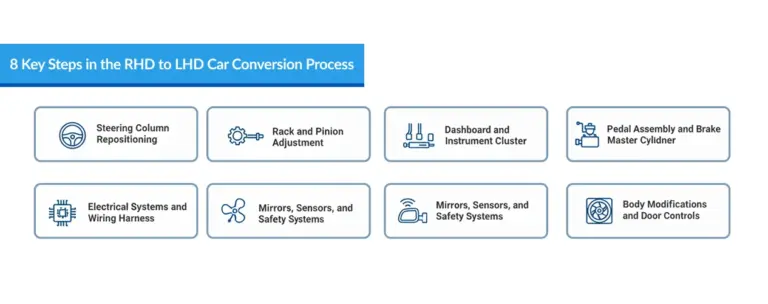
| Right-Hand Drive Conversion | $3,500-$5,000 | 14-21 days | UK, Australia, Japan, India |
| Suspension Adjustment (European comfort tuning) | $600-$900 | 2-3 days | Local homologation |
| Emergency Call System (eCall) Installation | $450-$700 | 1-2 days | EU mandatory safety |
| Speed Limiter Adjustment (local regulations) | $200-$350 | 1 day | Market-specific limits |
7. After-Sales Ecosystem: Securing Parts and Service Abroad
The Achilles’ heel of Chinese EV imports has historically been after-sales support. The 2026 export regulations specifically address this by requiring exporters to demonstrate service capability, but importers must verify these commitments.
Warranty Architecture
Chinese OEMs typically offer:
– Domestic Warranty: 5-8 years battery, 3-5 years vehicle
– Export Warranty: Historically limited or voided
Licensed exporters must now provide International Warranty Certificates (IWC) that are:
– Transferable to end-users in your market
– Backed by local service partnerships or spare parts guarantees
– Valid for the full term (not pro-rated for export markets)
Spare Parts Logistics
Critical components requiring local stocking:
- Battery Modules: High-value, dangerous goods classification requires specialized warehousing
- Electric Motors: Rare earth magnet components subject to export controls
- Infotainment Systems: Frequent software-hardware compatibility issues
- Body Panels: Aluminum-intensive designs requiring specialized repair facilities
Your agent should provide:
– Bonded Spare Parts Inventory: Pre-positioned in your market or regional hub
– Technical Training: Certification programs for local technicians on high-voltage systems
– Diagnostic Tool Access: OBD (On-Board Diagnostics) compatibility with local service equipment
OTA Update Infrastructure
Modern Chinese EVs rely heavily on OTA updates for:
– Battery management system optimization
– Autonomous driving feature improvements
– Infotainment enhancements
Ensure your agent facilitates international server access or local update mirrors. Vehicles trapped on Chinese servers may lose functionality or receive inappropriate updates for local conditions.
8. Avoiding Scams: How to Audit a Chinese EV Supplier
The 2026 licensing requirements have eliminated many bad actors, but sophisticated fraud persists. Importers must conduct rigorous due diligence.
The “Gray Market” Red Flags
Illegal Export Schemes:
– VIN Manipulation: New vehicles registered as “used” to bypass export licenses
– Spec Sheet Fraud: Advertising high-spec models while shipping de-contented versions
– Battery Swapping: Substituting premium NCM batteries with inferior LFP units post-inspection
– Software Locking: Vehicles shipped with region-locked software requiring ransom payments to unlock
Audit Checklist for Reliable Agents
Tier 1: Legal Verification
– [ ] MOFCOM License Verification: Request license number and verify against Ministry database
– [ ] Business License Scope: Ensure “New Energy Vehicle Export” appears in registered business activities
– [ ] Manufacturer Authorization: Original (not photocopied) authorization letters with anti-counterfeit features
– [ ] Tax Compliance: VAT general taxpayer status certificate
Tier 2: Financial Health
– [ ] Bank References: Tier-1 Chinese bank (ICBC, Bank of China, CCB) relationship confirmation
– [ ] Credit Report: China Enterprise Credit Information Publicity System check for litigation or penalties
– [ ] Insurance Coverage: Product liability and export credit insurance certificates
Tier 3: Operational Capability
– [ ] Warehouse Inspection: Physical audit of bonded storage facilities (battery safety compliance)
– [ ] Quality Control: ISO 9001 certification and pre-shipment inspection protocols
– [ ] Technical Team: Presence of certified high-voltage technicians on staff
– [ ] Software Capability: Demonstration of OTA update management for international markets
Tier 4: Reference Verification
– [ ] Export History: Bill of lading records for past 12 months (verify consistency with claimed volumes)
– [ ] Client References: Contact details for non-competing importers in your region
– [ ] Dispute Resolution: Arbitration clauses favoring neutral jurisdictions (Singapore, Hong Kong)
Digital Verification Tools
Utilize these platforms for real-time verification:
– MOFCOM Export License Database: Public query system for license validity
– China Customs (GACC) Enterprise Credit: Importer/exporter credit ratings
– National Enterprise Credit Information Publicity System: Business registration and shareholder verification
– Alibaba Cloud Qichamao: Corporate relationship mapping (identify shell companies)
9. Start Your Import Business with Electric Auto China
As Chief Export Consultant at Electric Auto China, headquartered in Shanghai’s Lujiazui Financial District, I have guided European, Middle Eastern, and Latin American fleet operators through the complexities of China’s 2026 export landscape. Our organization represents the evolution of the reliable China car agent—from simple trading intermediary to integrated supply chain architect.
Our Compliance-First Infrastructure
Electric Auto China operates under full MOFCOM licensing for 2026, with authorized export rights for tier-1 manufacturers including BYD, NIO, XPeng, Li Auto, and international brands manufacturing in China. Our compliance infrastructure includes:
- Pre-Certified Vehicle Pools: Inventory pre-homologated for EU, GCC, and ASEAN markets, reducing delivery time by 60%
- Carbon-Neutral Logistics: Solar-powered warehousing in Shanghai Yangshan Deep Water Port and Ningbo Zhoushan Port, with methanol-ready vessel partnerships
- Multi-Regional Assembly: Coordination with Thai and Indonesian facilities for “China Plus One” risk mitigation and tariff optimization
- Financial Structuring: In-house trade finance capabilities including yuan/euro/dollar hedging and VAT rebate management
Technical Integration Services
Unlike traditional trading companies, we provide:
– Software Localization: In-house engineering team for CCS2 charging conversions, language localization, and GDPR-compliant server migration
– Homologation Management: Direct relationships with European Notified Bodies and GCC certification authorities
– After-Sales Architecture: Regional spare parts hubs in Rotterdam (EU), Dubai (GCC), and São Paulo (LATAM) with 48-hour parts availability guarantees
The 2026 Partnership Framework
We offer three engagement models tailored to import scale:
1. Volume Partnership (500+ units annually)
– Direct factory allocation with priority production scheduling
– Custom specification development (fleet-specific software features)
– Dedicated account management and quarterly business reviews
2. Growth Partnership (100-499 units annually)
– Consolidated shipping with our volume clients
– Shared homologation costs across multiple importers
– Flexible financing terms (60-90 days LC options)
3. Market Entry Partnership (<100 units annually)
– Pilot program facilitation (10-unit minimums)
– Turnkey homologation and compliance packages
– White-label after-sales support for your brand
Risk Mitigation Guarantee
Every Electric Auto China contract includes:
– License Verification Warranty: Full refund if export documentation proves invalid
– Specification Guarantee: Third-party inspection at loading (SGS/Bureau Veritas) included in pricing
– Software Functionality: 12-month OTA update support for localized systems
– Spare Parts Availability: Bonded inventory commitment or cash compensation for delays exceeding 30 days
Next Steps for B2B Buyers
To initiate your 2026 EV import program:
- Market Analysis: Schedule a consultation to review your local homologation requirements and competitive positioning
- Sample Procurement: Evaluate 2-3 demonstration units through our licensed export channel
- Framework Development: Establish annual volume commitments and customized logistics protocols
- Launch Execution: Execute first commercial shipment with full compliance documentation and after-sales activation
The Chinese EV export market in 2026 rewards prepared, compliant, and strategically positioned importers while penalizing those who fail to navigate the new regulatory complexity. By partnering with a reliable China car agent possessing deep licensing credentials, multi-regional logistics capabilities, and technical integration expertise, you position your business to capture the structural growth of global EV adoption while mitigating geopolitical and regulatory risks.
Contact Electric Auto China’s export division today to receive your customized landed cost analysis and regulatory roadmap for your target markets. The future of automotive supply chains is being written in Shanghai—ensure your business is part of that narrative.
Unlock High-Margin EV Imports with Electric Auto China
As an elite automotive supply chain partner in Shanghai, we provide end-to-end, strictly compliant export solutions tailored for international dealerships, fleet managers, and wholesale distributors.
- 🛡️ 100% Legal & Compliant: Fully licensed exports ensuring smooth customs clearance at your destination.
- ⚙️ Complete Localization: Professional English/Arabic/Russian OS flashing and GB/T to CCS2 charging solutions.
- 🚢 Secure Logistics: Direct Ro-Ro and Containerized shipping with full UN38.3 battery certifications.
- 🔧 After-Sales Support: Reliable access to OEM diagnostic tools and steady spare parts supply.
Request a Detailed FOB/CIF Quote Today:
📧 B2B Sales Email: [email protected]
💬 Direct WhatsApp: +86 159 5127 6160